
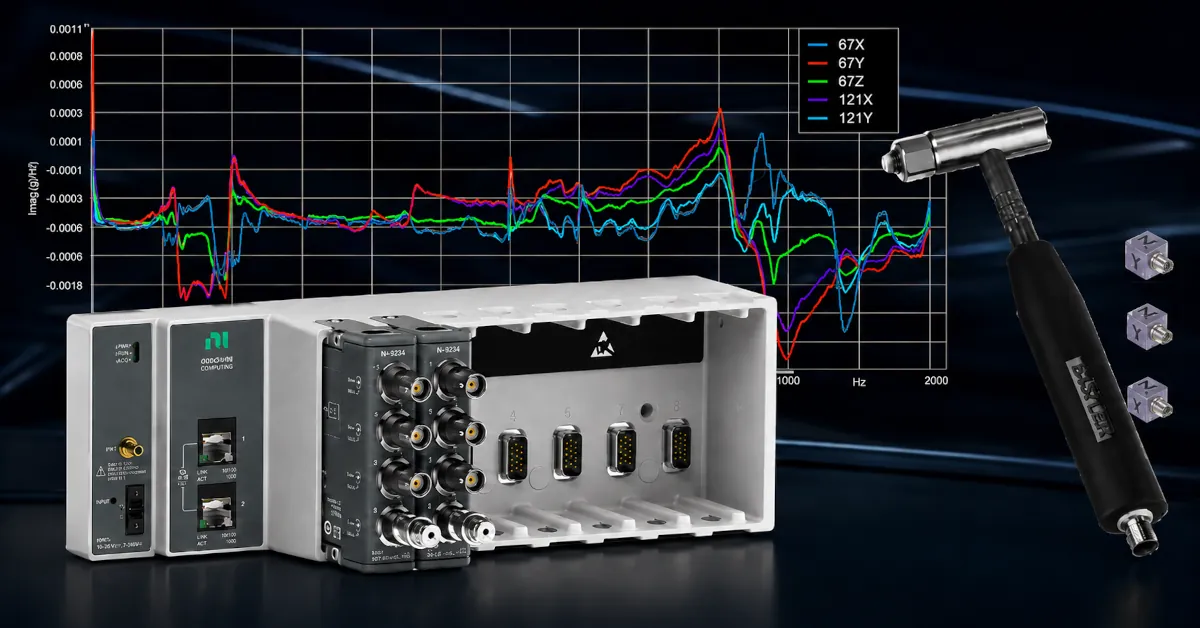
A valuable resource for engineers working in testing, measurement, and design validation.
Understanding how structures vibrate — and why — is essential across nearly every engineering discipline. Whether you’re working on rotating machinery, industrial equipment, robotics, medical devices, heavy vehicles, consumer products, or building-scale installations, experimental modal analysis (EMA) provides the insight needed to predict performance, improve reliability, and validate designs.
That’s why we’re excited to highlight a resource from our strategic partner 6D Testing & Analysis (6D): “An Engineer’s Guide to Experimental Modal Analysis.” (Note: email signup is required.)
This guide is written for engineers at all levels who need a practical, accessible reference on modal testing fundamentals and real-world best practices.
What the Guide Covers
6D’s guide provides a step-by-step overview of the modal analysis process, including:
- What modal analysis is and why it matters
- Key concepts such as natural frequency, mode shape, and damping
- Differences between impact hammer and shaker excitation
- Best practices for sensor and accelerometer placement
- Tips for ensuring measurement quality and coherence
- Curve fitting, modal parameter extraction, and interpretation
- How modal results are used for design validation and correlation to FEA
The guide blends engineering theory with field-proven techniques, making it useful across industries — from manufacturing and automotive to aerospace, research labs, and civil structures.
How ITM Uses Modal Testing Across Industries
At Integrated Test & Measurement, we regularly incorporate modal analysis into structural testing and design-validation programs. Our customers rely on modal data to:
- Correlate and validate finite element (FEA) models
- Detect resonances that could impact durability or noise
- Improve stiffness, rigidity, and vibration performance
- Troubleshoot unexpected dynamic behavior in prototypes
- Inform design decisions before scaling up to production
ITM supports these efforts with comprehensive instrumentation and test services, including:
- On-site strain gauge installation and measurements
- Wireless strain monitoring for applications where cables are impractical
- High-channel DAQ rental systems and rugged field hardware
- Custom LabVIEW® applications for acquisition and analysis
- Field- and lab-based experimental modal analysis
- Long-term vibration monitoring and design validation support
Whether you’re evaluating a machine frame, refining a structural prototype, or trying to understand dynamic behavior in a complex assembly, modal analysis helps uncover the root of the problem — and ITM provides the tools and expertise to help you act on those insights.
Who Should Download This Guide?
This guide is ideal for:
- Mechanical, structural, test, and R&D engineers
- Product development and prototyping teams
- Reliability and durability specialists
- Engineering students or new hires learning structural dynamics
- Anyone planning, conducting, or interpreting a modal test
If your work involves vibration, fatigue, FEA correlation, troubleshooting, or design optimization, this guide will be immediately useful.
Get the Guide
You can download “An Engineer’s Guide to Experimental Modal Analysis” at the link below (email signup required):
Need help applying these concepts? From instrumentation and data collection to analysis and reporting, ITM supports every step of your modal test.
Related solutions
Testing Services
Field- and lab-based modal analysis, structural testing, and FEA correlation. Explore →
iTestSystem Software
Impact Test DAQ, FRF Viewer, and 3D Animator for modal acquisition and analysis. Explore →
DAQ Systems
High-channel DAQ rental systems and rugged field hardware for modal testing. Explore →
Recent insights
-
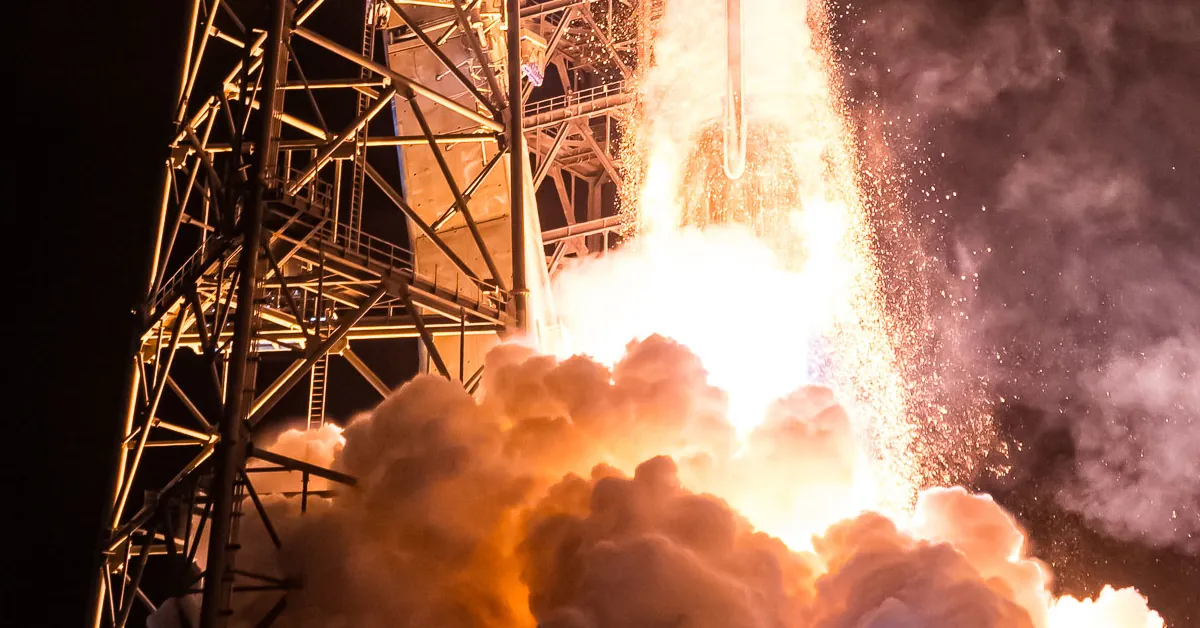 Aerospace Engineering, Aerospace Testing, Blue Origin, Engineering, ESCAPADE Mission, Launch Vehicle Engineering, New Glenn, Rocket Reliability, Strain Measurement, structural health monitoring, Structural Testing
How Pre-Launch Structural Testing Ensures Mission Success
When Blue Origin’s New Glenn rocket successfully launched NASA’s ESCAPADE mission to Mars, it marked a historic step forward for commercial launch technology — and a testament to the unseen engineering that happens long before a vehicle ever reaches…
-
 AWS IoT Analytics, cDAQ-9189, Channel Synchronization, CompactDAQ, Condition-Based Maintenance, Edge-to-Cloud High-Channel Datalogging, Engineering, Instrumentation, iTestSystem, iTestSystem Automated Analytics, iTestSystem Notification Service, NI-9236, NI-9469, Strain, Stress, structural health monitoring
High Channel Count Synchronous Datalogging
When a manufacturer needed to validate the structural performance of a 38-ton on-highway vehicle, ITM deployed a 200+ channel synchronous datalogging system capable of capturing accelerometer, strain, GPS, and speed data at nearly 2 kS/s per channel…
-
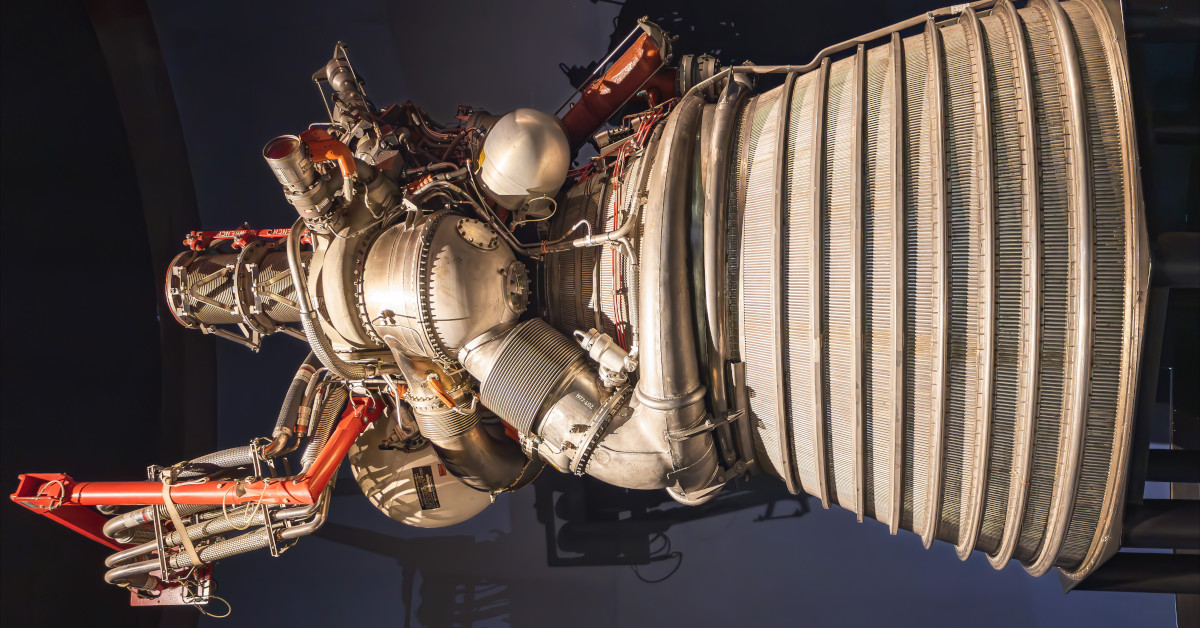
ITM Engineers Contribute to Advancements in RL10C-X Rocket Technology
At ITM, we take pride in playing a crucial role in cutting-edge aerospace developments. One such example is our involvement with the RL10C-X rocket engine, a part of the ongoing evolution of space technology discussed in the Aerospace America article. The RL10 series has long been known as a gold standard in upper-stage rocket engines,…