
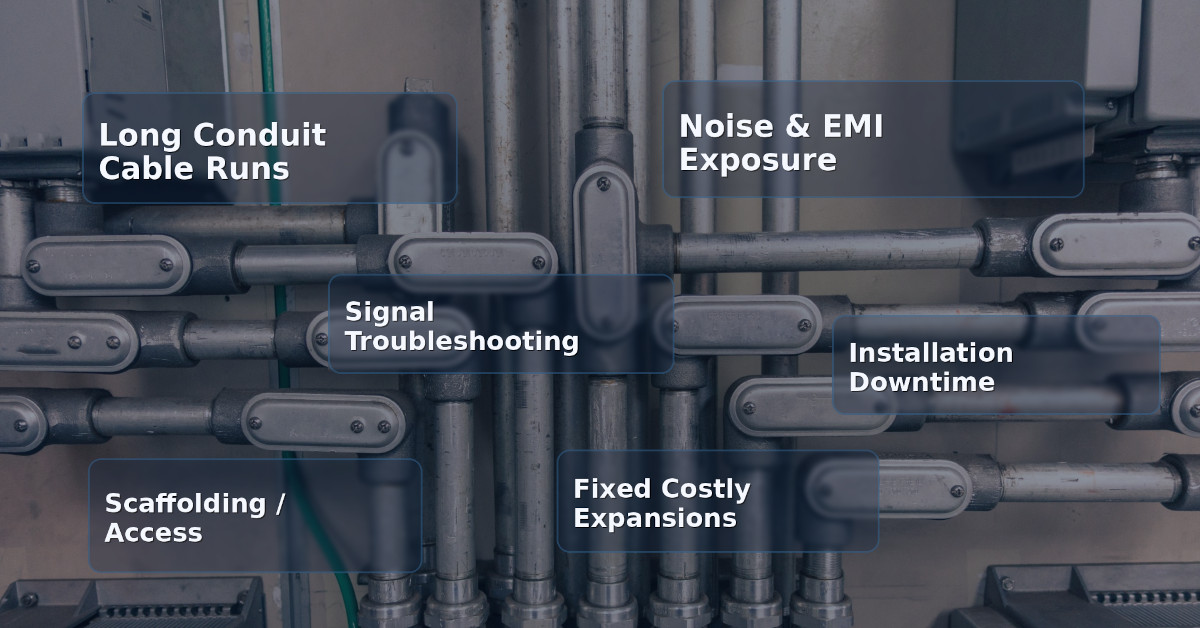
For decades, hardwired data acquisition has been the default standard for industrial monitoring. From strain gauges on structural supports to thermocouples in recovery boilers, running conduit and pulling cable has been considered the “safe” engineering choice.
But that assumption deserves re-evaluation.
With advances in industrial wireless architecture, edge processing, and signal conditioning, wireless monitoring is no longer a compromise solution — it is often the smarter engineering decision.
At ITM, we design and deploy both hardwired and wireless systems. This article outlines when each approach makes sense — and where wireless delivers measurable advantages.
The Traditional Case for Hardwired Monitoring
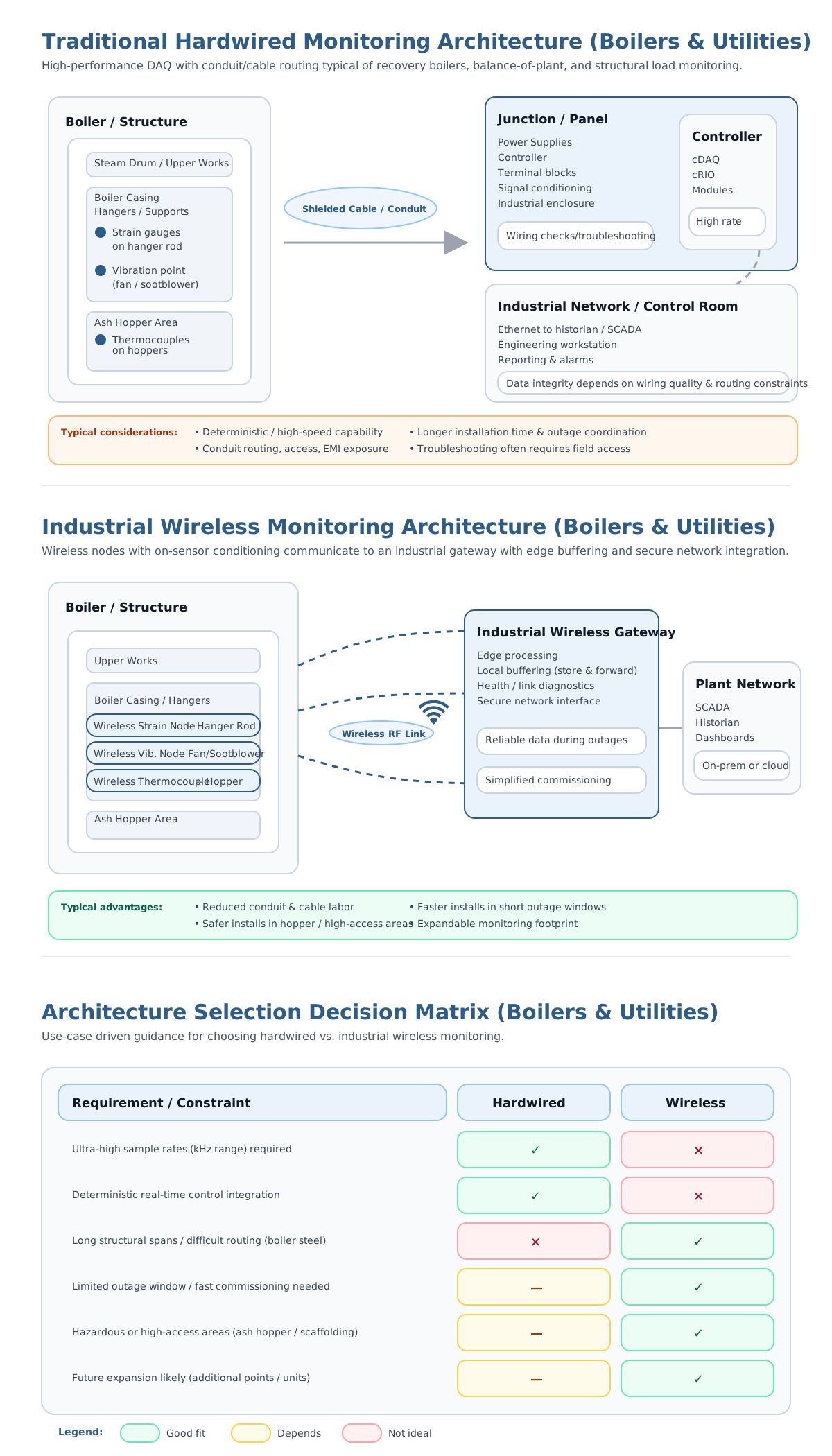
Hardwired systems remain ideal when:
- Ultra-high sampling rates are required
- Deterministic, real-time control loops are involved
- Facilities already have established conduit infrastructure
- Regulatory or nuclear environments require fully wired systems
Systems built around platforms such as NI CompactDAQ or CompactRIO are often preferred for deterministic / real-time control applications.
Hardwired is not outdated — it is simply not always optimal.
The Real Cost of “Just Running Cable”
In many industrial environments, installing conduit and cable introduces:
- Extended outage windows
- Significant labor cost
- Electrical noise exposure
- Physical routing constraints
- Increased safety risk during installation
In recovery boilers, for example, installing thermocouple wiring near hopper areas can increase exposure to ash bridging hazards. In structural monitoring applications, pulling cable across large boiler structures or bridges can require scaffolding, lifts, and weeks of coordination.
In these scenarios, the installation cost often exceeds the sensor cost.
Wireless Monitoring Advantages
Wireless monitoring systems have become an effective alternative to traditional hardwired instrumentation in many industrial environments. In facilities such as power plants, pulp and paper mills, and large manufacturing sites, running conduit and signal wiring to each measurement point can significantly increase installation time, cost, and operational disruption.
Wireless sensor networks reduce these challenges by allowing measurement devices to communicate directly with a gateway or edge processor without extensive cable infrastructure.
Reduced Installation Time
One of the most significant advantages of wireless monitoring is the reduction in installation complexity. Hardwired monitoring systems often require long conduit runs, cable routing through structural steel, and coordination with plant outages. Wireless systems can often be installed in a fraction of the time because sensors communicate directly to a nearby gateway.
This can be especially valuable in facilities where outage windows are short and equipment access may require scaffolding or specialized safety procedures.
Lower Infrastructure Cost
Eliminating long cable runs and conduit installation can substantially reduce project costs. In large industrial structures such as boilers, monitoring points may be separated by tens or hundreds of feet. Wireless systems minimize the need for junction boxes, cable trays, and additional control panel wiring.
In many cases, the installation savings alone can offset the cost of the wireless hardware.
Improved Safety During Installation
Certain measurement points — such as boiler hanger rods, ash hopper structures, and elevated equipment platforms — can be difficult to access. Installing conduit and wiring in these areas often requires extended work at height or around operating equipment.
Wireless monitoring systems reduce the amount of physical infrastructure required in these locations, which can help minimize installation risk.
Expandable Monitoring Networks
Another advantage of wireless systems is their flexibility. Additional monitoring points can typically be added without installing new conduit or signal wiring back to a central panel. Sensors can be integrated into the existing wireless network and begin transmitting data with minimal disruption to plant operations.
This scalability allows facilities to expand monitoring coverage over time as reliability programs mature.
Access to Previously Unmonitored Assets
Wireless systems also make it practical to monitor assets that were previously considered too expensive or difficult to instrument. Structural loads, vibration points, and temperature measurements can often be added to equipment that historically operated without direct instrumentation.
As a result, wireless monitoring can significantly increase the visibility of equipment health and operating conditions across a facility.
Addressing Common Engineering Concerns
While wireless monitoring systems provide clear installation and flexibility advantages, engineers often have questions regarding reliability, communication performance, cybersecurity, and long-term operation in industrial environments. Modern industrial wireless systems are specifically designed to address these concerns.
Communication Reliability
Industrial environments contain large steel structures, electrical equipment, and other sources of electromagnetic interference. Modern wireless monitoring systems mitigate these challenges through techniques such as mesh networking, adaptive frequency selection, and redundant communication paths.
These capabilities allow wireless networks to maintain reliable communication even in complex industrial facilities such as power plants, pulp mills, and utility boilers.
Data Integrity and Availability
Another common concern is the ability to maintain reliable data collection during network interruptions. Many industrial wireless gateways incorporate edge buffering and store-and-forward capabilities that allow sensor data to be temporarily stored if a network connection is interrupted.
Once connectivity is restored, the data is transmitted to the monitoring system, helping ensure measurement continuity.
Cybersecurity
Security is an important consideration when introducing wireless systems into industrial environments. Modern industrial wireless monitoring systems typically incorporate multiple security mechanisms including encrypted communications, secure device authentication, and controlled network access.
In many deployments, wireless gateways interface with plant networks through established IT or OT security controls such as firewalls, segmented networks, and secure protocols. These protections help ensure that wireless monitoring systems can be integrated into existing infrastructure while maintaining the cybersecurity standards required for industrial facilities.
Power and Maintenance
Wireless sensors are often designed for low-power operation, allowing them to run for extended periods using battery power or local energy sources. In many industrial monitoring applications, this enables sensors to operate for years before maintenance is required.
This approach reduces the need for additional power wiring while still supporting long-term monitoring programs.
Network Scalability
Engineers frequently need to expand monitoring coverage over time as reliability initiatives evolve. Wireless systems allow additional sensors to be integrated into an existing network without installing new conduit runs or signal wiring.
This scalability allows facilities to gradually increase instrumentation coverage across critical assets without major infrastructure modifications.
Suitability for Industrial Monitoring
When properly designed and deployed, wireless monitoring systems can provide reliable performance for many measurement applications including structural load monitoring, vibration measurements, and temperature monitoring.
For applications that require extremely high sampling rates or deterministic control integration, hardwired systems may still be preferred. However, for many monitoring applications, wireless technology provides a practical and efficient alternative.
Real-World Deployment Example
In a southern recovery boiler installation, conduit routing for 40+ hanger rod strain measurement locations would have required extensive structural access and multi-week labor.
By deploying industrial wireless strain nodes and centralized gateways, the installation window was reduced significantly, avoiding major structural routing work and shortening outage duration.
The result: faster deployment, lower installation cost, and improved scalability for future monitoring expansion.
The Engineering Decision Framework
The correct question is not “hardwired or wireless?”
The correct question is:
- What sampling rate is required?
- What installation constraints exist?
- What safety risks are present?
- What is the lifecycle expansion plan?
- What is the true installed cost?
Industrial Wireless Communication Technologies
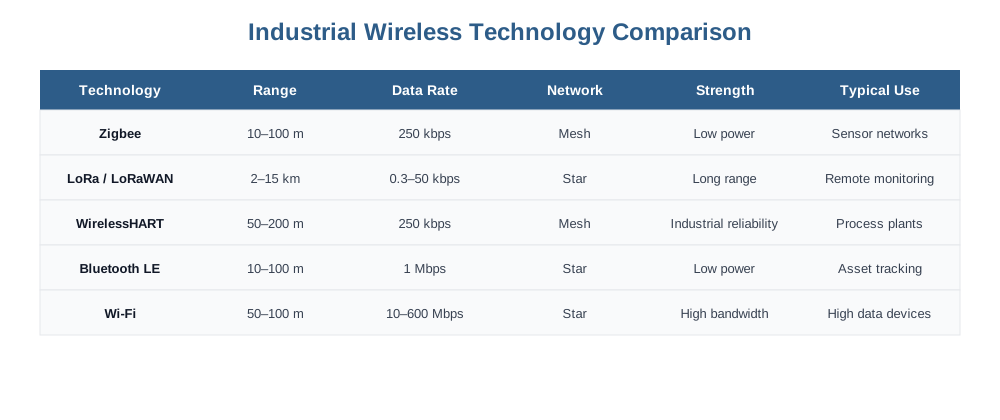
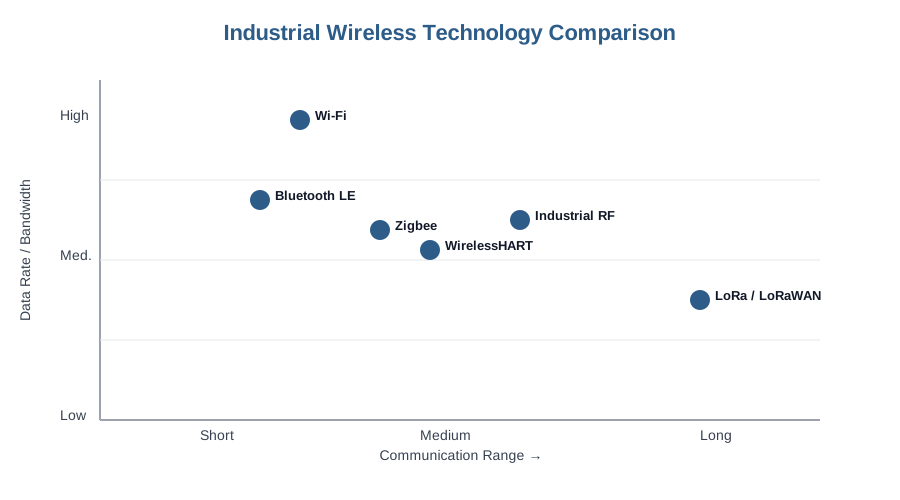
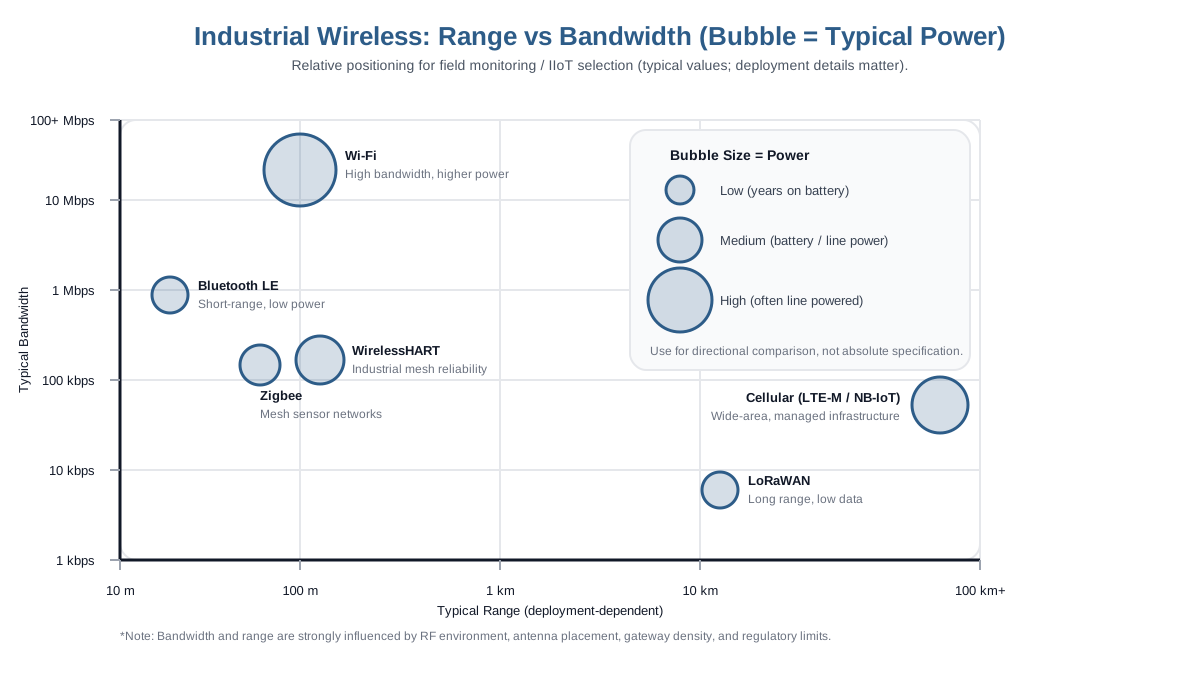
Industrial wireless monitoring systems commonly use protocols such as Zigbee, WirelessHART, LoRaWAN, Wi-Fi, and Bluetooth Low Energy depending on range, bandwidth, and power requirements.
Engineering Summary
Both hardwired and wireless monitoring systems play important roles in industrial measurement and reliability programs. Hardwired systems continue to provide advantages for applications that require extremely high sampling rates, deterministic communication, or direct integration with control systems.
However, advances in industrial wireless technology have made wireless monitoring a practical solution for many measurement applications. Wireless sensor networks can significantly reduce installation complexity, minimize conduit and wiring requirements, and allow monitoring systems to be deployed in areas where traditional instrumentation would be difficult or costly to install.
For many facilities, the most effective approach is not strictly hardwired or wireless, but rather a combination of both architectures. Hardwired systems may be used for high-speed measurements or control-related instrumentation, while wireless sensors can expand monitoring coverage to structural components, vibration points, and other assets that were previously uninstrumented.
When evaluating monitoring solutions, engineers should consider several key factors including sampling requirements, communication reliability, installation constraints, and long-term maintainability. By selecting the appropriate architecture and communication technology for each application, facilities can implement monitoring systems that provide reliable data while remaining practical to install and expand over time.
Weighing hardwired vs. wireless for your facility? Talk to the engineers who deploy both.
Related solutions
Packaged Solutions
Turnkey industrial monitoring systems — hardwired, wireless, or hybrid. Explore →
Wireless Sensor Networks
Mesh wireless strain, vibration, and temperature nodes with edge gateways. Explore →
Structural Load Monitoring
Continuous monitoring of hanger rods, structures, and critical assets. Explore →
Recent insights
-
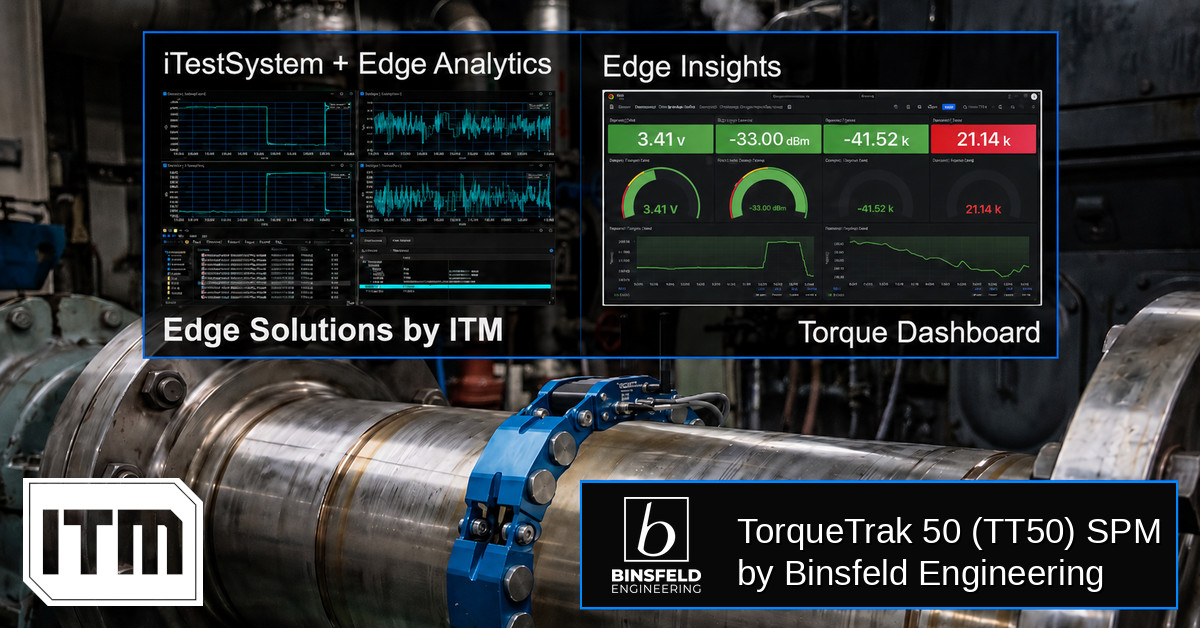
Torque-based Edge Insights: ITM iTestSystem Automated Analytics + Binsfeld TT50
In industrial and marine environments, the drivetrain is often the most critical — and least monitored — part of the system. Rotating shafts transferring torque through gearboxes, couplings, and propellers generate enormous forces that, left unmeasured, become the root cause of unexpected failures, unplanned downtime, and costly maintenance cycles. Traditional torque measurement solutions require shaft…
-
 Boiler Efficiency, boiler safety, Edge Solutions, intelligent boiler cleaning, ITM monitoring systems, Predictive Maintenance, sootblower monitoring
Smarter Cleaning, Safer Boilers with ITM’s Monitoring Systems
The Business Case for ITM’s Sootblower Intelligent Maintenance and Fouling-Directed Cleaning Solutions Executive Summary Sootblowers are essential for keeping recovery, biomass, and power boilers clean and efficient. However, without proper monitoring and maintenance, they can become hidden sources of steam waste, mechanical failures, and even safety risks. Integrated Test and Measurement (ITM) has developed the…
-
 Boiler Efficiency, Boiler Pulse Cleaning, Edge Solutions, Fouling Detection, Industrial Boiler Solutions, ITM White Papers, Recovery Boiler Optimization, Sootblower Maintenance, Strain Based Monitoring, Vibration-Based Monitoring
Pulse Cleaning Optimization with ITM Monitoring Technologies
Optimizing Pulse Cleaning with ITM’s Patented Vibration-Based Fouling Detection and Fouling Monitoring System Executive Summary Boiler operators are under constant pressure to maximize efficiency, control fuel costs, and minimize downtime. To combat slagging and fouling, many plants deploy high-energy cleaning technologies such as shock pulse, acoustic cleaning, impulse systems, and other energy-pulse methods. These approaches…