
Edge Solutions
ITM Connect CleanPass — Recovery Boiler Fouling & Sootblower Performance
“See where the boiler is fouling — and whether every sootblower pass is cleaning it.”
ITM Connect CleanPass
- Shows where deposits are building, by tube section and by sootblower lane, while they can still be removed.
- Checks every blow of every sootblower — a pass that ran without cleaning is flagged the same shift.
- Gives maintenance a ranked fix-first list: poppet valve leaks, rack and pinion damage, carriage faults and weak jets.
- Brings ITM’s SFD and FMS technologies into one modular application — start with one module, then add the rest.
- Built on ITM’s patented vibration technology for detecting and monitoring deposits, on both the sootblowers and the boiler — US 10,094,660 B2 and its patent family.
CleanPass Application
Sootblowing in a kraft recovery boiler runs mostly on a fixed sequence, with little direct evidence of where the deposit is or what each blow achieved. CleanPass measures the boiler and the sootblowers directly: accelerometers on each sootblower and on the boiler structure, strain gauges on the hanger rods, and the signals already in the sootblower controller or DCS feed one application. Running on an ITM Compute edge computer with ITM Connect, it turns every sootblower operation into a small set of indicators and plain-language actions for operators, maintenance and process engineers — and publishes every indicator and alarm to the mill’s own systems.
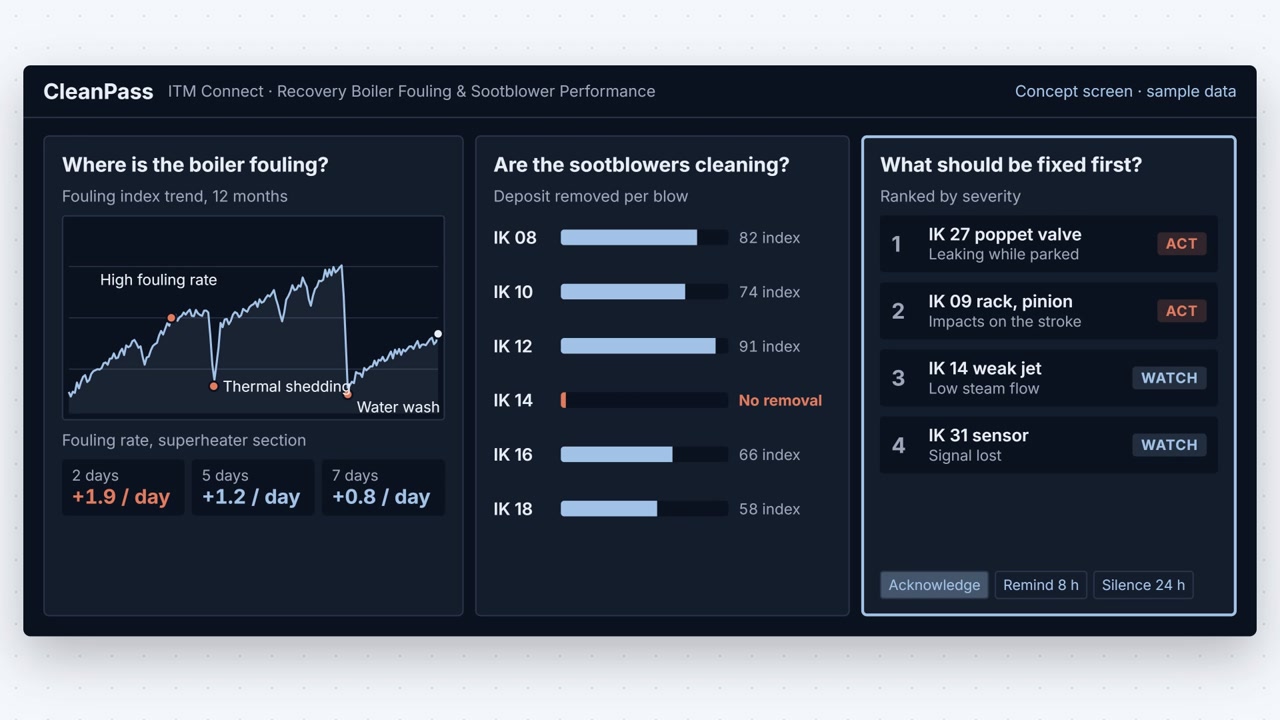
- Where is the boiler fouling? — fouling level and rate by section and by sootblower lane, deposit weight by zone, and a map of where the jet contacts heavy deposit along each lane.
- Are the sootblowers cleaning? — deposit removed per blow, jet strength against the sootblower’s own normal and against its peers, and blows that ran without removing anything.
- What should be fixed first? — a ranked list of sootblowers with mechanical faults, leaking or stuck poppet valves, weak or starved jets, and failed sensors.
- Plain-language actions — each finding is an action at Watch or Act level. Operators acknowledge it, ask to be reminded in 8 hours or silence it for 24 hours, and CleanPass records who responded.
- Calibrated to your boiler — thresholds are set by hand or calibrated to each sootblower’s own normal operation. Alarms stay off until the mill has calibrated them.
- Works with what the mill has — integrates with fixed-sequence sootblower controls or a sootblower vendor’s intelligent sootblowing package, over Modbus TCP or EtherNet/IP.
At a glance: 5 measurement modules, 1 application · every blow of every sootblower measured · vibration indicators calculated at the edge · Modbus TCP and EtherNet/IP · developed on more than 10,000 recorded sootblower operations · US 10,060,688 B2, US 10,094,660 B2 and US 10,724,858 B2.
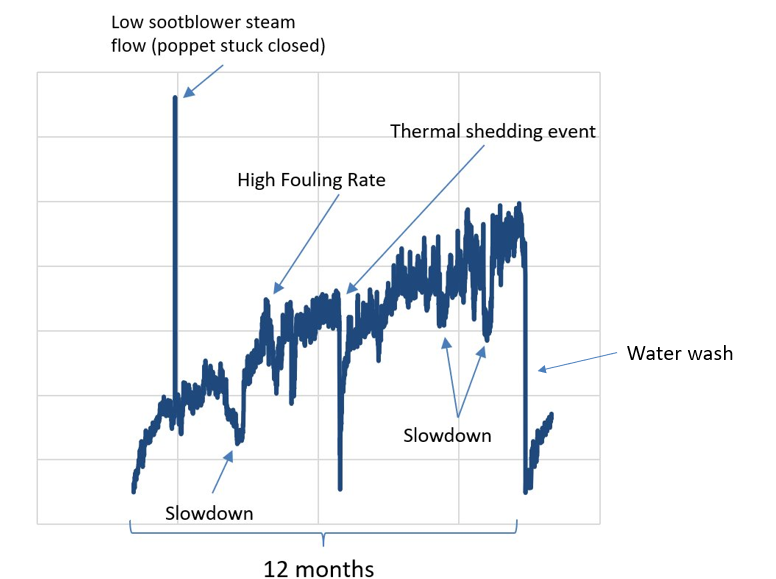
Measuring every blow is the differentiator. A fixed sequence blows clean lanes as often as fouled ones, and a blow that runs is assumed to be a blow that cleans. CleanPass measures every pass, in and out — so a deposit shows as a rising fouling rate days before draft loss does, and a poppet that failed to open, a starved header or a weak jet is flagged instead of completing the sequence unnoticed. The vibration method, on both the sootblowers and the boiler, is covered by a family of ITM patents. The trend shown is twelve months on one section: the index climbs through periods of high fouling rate, drops at a thermal shedding event and again at the water wash, and spikes once, when a poppet valve stuck closed starved a sootblower of steam.
Five modules. One application.
CleanPass is built from five measurement modules and one application. A mill installs the modules that fit its boiler, and CleanPass shows only the indicators those modules support. For mills that already run ITM’s FMS or SFD, the modular design is a maintenance and upgrade path: the existing installation is brought into CleanPass as modules, kept current, and extended with new modules over time.
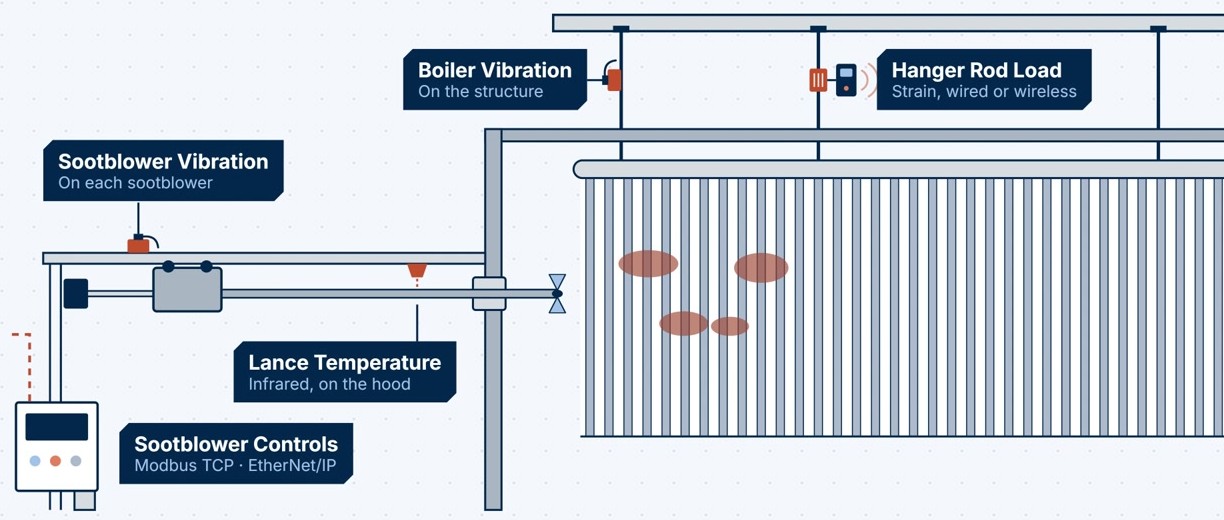
Sootblower Vibration (SBV)
Boiler Vibration (BV)
Hanger Rod Load (HRT)
Lance Temperature (SLT)
Sootblower Controls
CleanPass application
Typical payback
A full CleanPass installation typically pays back in 5 to 10 months. ITM’s boiler monitoring installations typically save on the order of $500,000 a year, and on large recovery boilers the savings can exceed $2 million a year. The largest value comes from redirecting sootblowing to where the fouling and buildup are, and from keeping every sootblower in top condition so each blow cleans at full strength — fewer water washes and unplanned outages, sustained boiler throughput and less tube erosion. CleanPass does not depend on cutting steam: expect some reduction in overall sootblowing steam, with the steam that is used doing more cleaning.
| Source of value | Annual savings potential |
|---|---|
| Downtime avoidance and water washes | More than $500,000 per event |
| Boiler efficiency improvements | $100,000 to $200,000 |
| Maintenance savings | $30,000 to $50,000 |
| Capital expenditure avoidance | $50,000 or more per sootblower |
| Leak elimination | $50,000 to $200,000 |
| Steam optimization | $100,000 to $500,000 |
| Chloride chemistry control | $250,000 to $500,000 |
| Total | $500,000 to more than $2 million |
Typical figures. Source: Smarter Cleaning, Safer Boilers with ITM’s Monitoring Systems. A mill does not have to buy the full system at once — start with one module and add the others later.
Safety
Sootblower faults are a recovery boiler safety issue. CleanPass checks every sootblower on every blow for the conditions that industry safety guidance asks mills to watch: lance and nozzle failures, leaking poppet valves, packing leaks that release steam where people work, and carriages that fail to retract. It adds a continuous check between operator walk-downs.
| BLRBAC published learning | What CleanPass provides |
|---|---|
| Develop a method to indicate leaking poppet valves | The poppet indicator on the Sootblower Vibration module, with the Lance Temperature module as a second, independent check |
| Witness the operation of each sootblower on a regular basis | Every blow of every sootblower is measured, not sampled on a walk-down |
| Check sootblower alignment so lances do not rub tubes | Mechanical fault indicators that flag impacts and rubbing along the stroke |
| Set end-of-life criteria for blowers and lances rather than running to failure | Health trends for each sootblower and a ranked fix-first list |
| Establish blowing pressures for each area and check them periodically | Jet strength measured on every pass, against the sootblower’s normal and its peers |
CleanPass is a condition monitoring system. It supports, and does not replace, the boiler’s safety systems, the emergency shutdown procedure and operator walk-downs.
How it deploys
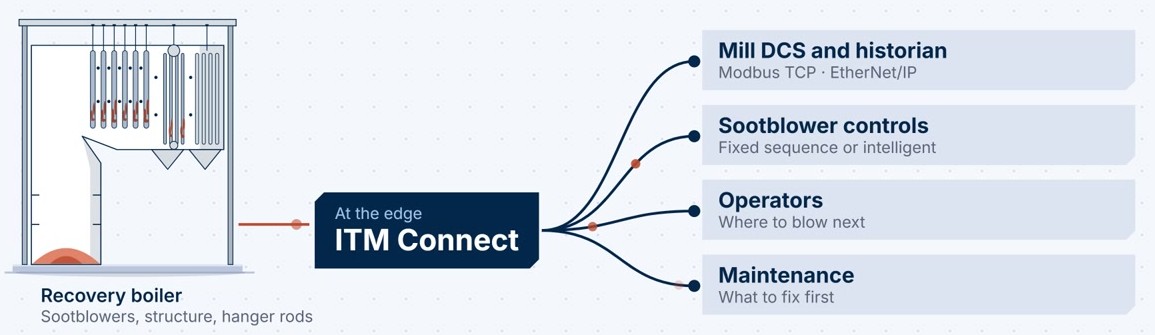
- Install the modules chosen for the boiler. Sensors mount on the sootblowers, the boiler structure and the hanger rods. Wireless sensor nodes are available for hanger rods and boiler vibration.
- Connect the sootblower controller or DCS. ITM Connect reads sootblower state and steam header signals over Modbus TCP or EtherNet/IP.
- Run and calibrate. CleanPass calculates every indicator from the first day. Alarms stay off until the mill calibrates normal levels on its own boiler.
- Turn on views in phases. The first phase covers sootblower mechanical health, jet strength, lane fouling, section fouling and poppet valves. Hanger rod shedding, steam header and lance temperature views follow as their modules are added.
ITM configures and maintains the platform. The mill’s administrators own thresholds, alarm timing and user access.
References: published sources behind this page and the CleanPass overview film.
- “Smarter Cleaning, Safer Boilers with ITM’s Monitoring Systems”, M. Yeager, ITM, September 2025 — SFD and FMS, leak and incident costs, and the annual savings table.
- D. Tandra, Clyde Industries, “Sootblowers: Operating Issues, Maintenance and Optimization”, TAPPI Kraft Recovery Operations Course — sootblowing steam use, sootblower-related downtime reported to BLRBAC, and sootblower age.
- BLRBAC ESP Subcommittee, Published Learnings and incident summaries — the sootblower learnings in the safety table.
- 2026 Recovery Boiler Operational Safety Seminars, AF&PA, August 2026 — 2025 incident counts and the share found on operator walk-downs.
- “Corrosion Damage and In-Service Inspection of Retractable Sootblower Lances in Recovery Boilers”, F. A. Paoliello, TAPPI Journal, October 2021 — lance failures and their consequences.
- US 10,094,660 B2, “System and methods for detecting, monitoring, and removing deposits on boiler heat exchanger surfaces using vibrational analysis”, assigned to Integrated Test & Measurement (ITM) LLC — same patent family: US 10,060,688 B2 and US 10,724,858 B2.
Built on ITM’s Sootblower Fouling Detection (SFD) and Fouling Monitoring System (FMS); indicators developed on more than 10,000 recorded sootblower operations from two operating recovery boilers.
Next step: start with one module, then add the rest.
Talk to an engineer: (844) 837-8797 · info@iTestSystem.com
Related Edge Solutions resources
-

Wireless Torque. Connected Fleet. Meet ITM at the International WorkBoat Show 2026
Visit ITM at the International WorkBoat Show in New Orleans, Dec. 2–4, 2026, and see how ITM Connect turns shaft torque into insight for one vessel or a fleet.
-
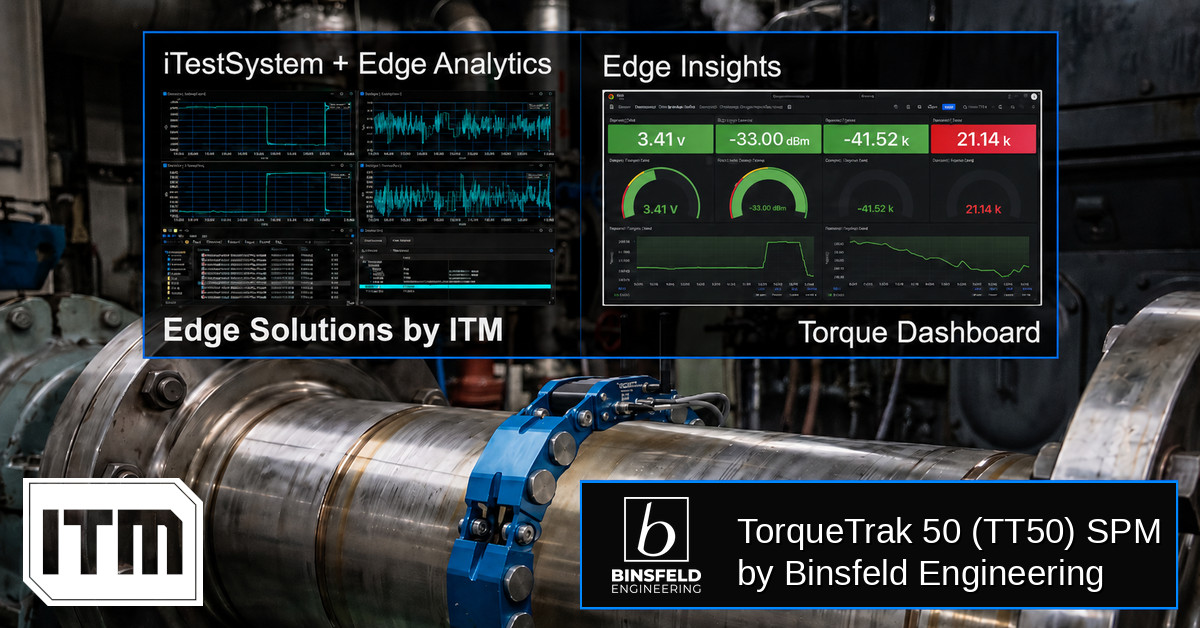
Torque-based Edge Insights: ITM iTestSystem Automated Analytics + Binsfeld TT50
In industrial and marine environments, the drivetrain is often the most critical — and least monitored — part of the system. Rotating shafts transferring torque through gearboxes, couplings, and propellers generate enormous forces that, left unmeasured, become the root cause of unexpected failures, unplanned downtime, and costly maintenance cycles. Traditional torque measurement solutions require shaft…
-
 Ash Hopper Monitoring, Boiler Monitoring, Condition Monitoring, Edge Solutions, Industrial Data Acquisition, industrial IoT, Industrial Monitoring, Power Plant Monitoring, Predictive Maintenance, Recovery Boiler, sootblower monitoring, Strain Gauge Monitoring, Thermocouple Monitoring, vibration monitoring, Wireless Monitoring
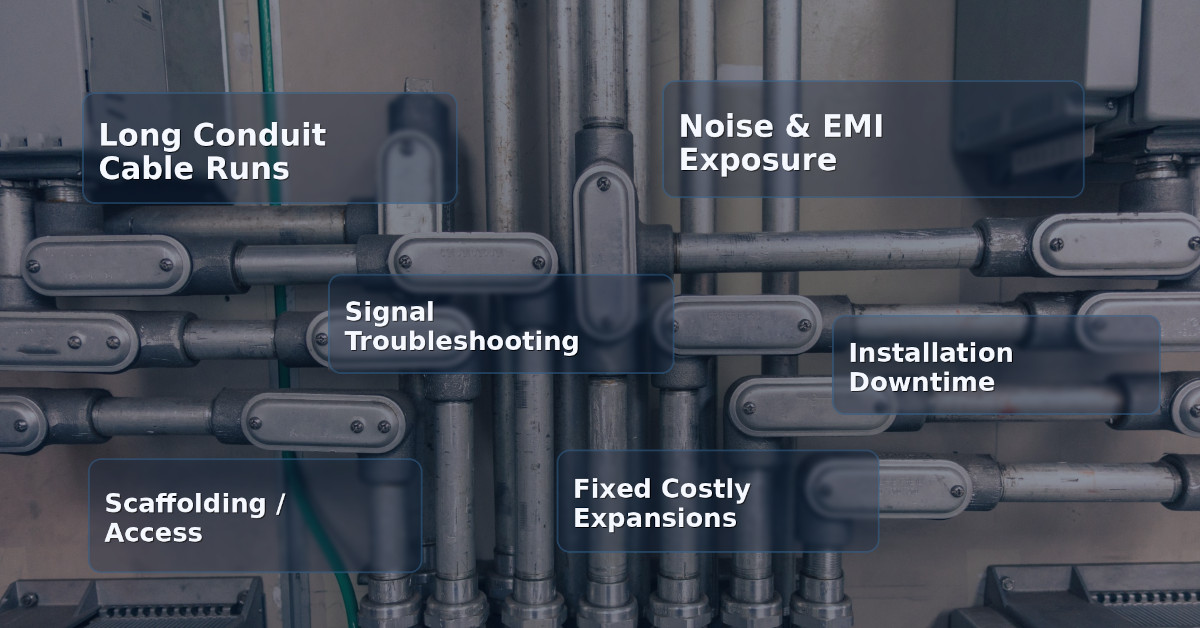
Hardwired vs. Wireless Industrial Monitoring: When Does Wireless Actually Make Sense?
For decades, hardwired data acquisition has been the default standard for industrial monitoring. From strain gauges on structural supports to thermocouples in recovery boilers, running conduit and pulling cable has been considered the “safe”…