
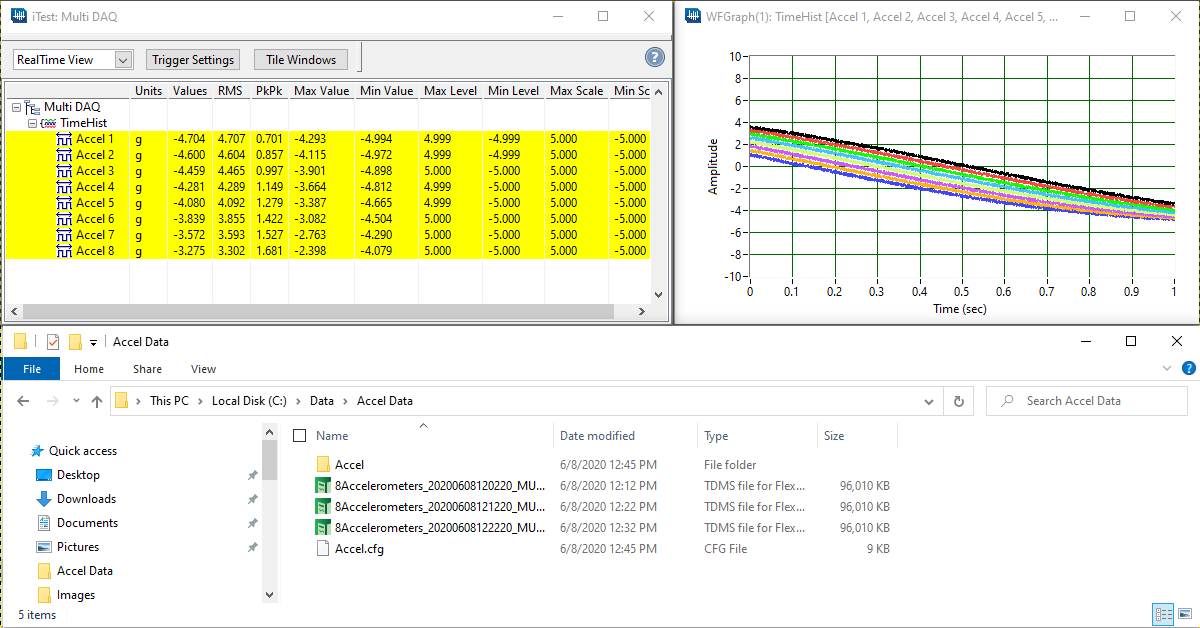
When streaming high speed data over a long period of time it is important to estimate data file size to avoid filling up your drive and also to prevent producing large, unwieldy data files. I usually try to keep file sizes less than one (1) gigabyte (FAT 32 maximum file size is 4 gigabytes) to minimize potential data losses and to make sure data transfers, analysis, and plotting don’t take too long. Whether you are using the free version of iTestSystem to manually control data file size or the paid version to automatically control file size, it is important to estimate your file size before collecting data.
iTestSystem uses the standard binary TDMS file format to stream high speed data to disk. Estimating file size depends on five (5) things.
- Header Size (Negligible for large files)
- Number of Channels
- Data Type Size in Bytes
- Sample Rate
- Logging Duration
File Size Formula = ((Number of Channels) x (Data Type Size (bytes)) x (Sample Rate (Samples/Second)) x (Logging Duration (Seconds))) + Header Size
TDMS File Size Estimator Spreadsheet
File Size Example: Eight (8) Accelerometer Channels sampled at 2560 Samples/Second are logged as a double (8 Bytes) for 600 seconds to a TDMS data file. Estimated file size = (8 x 8 x 2560 x 600) = 98,304,000 bytes or 96,000 KB (98,304,000 bytes/1024 bytes / KB).
For more information about iTestSystem or file sizes, contact Chase Petzinger @ (844) 837-8797 x704.
Planning a high-speed data logging campaign? Talk to the engineers behind iTestSystem.
Related solutions
iTestSystem Software
The acquisition, analysis, and automated-analytics platform that streams TDMS data to disk. Explore →
Data Acquisition
High-channel-count DAQ systems for streaming accelerometer, strain, and mixed-signal data. Explore →
Edge Solutions Platform
Continuous, unattended data logging and automated analytics at the edge. Explore →
Recent insights
-
 Aerospace Engineering, Aerospace Testing, Blue Origin, Engineering, ESCAPADE Mission, Launch Vehicle Engineering, New Glenn, Rocket Reliability, Strain Measurement, structural health monitoring, Structural Testing
How Pre-Launch Structural Testing Ensures Mission Success
When Blue Origin’s New Glenn rocket successfully launched NASA’s ESCAPADE mission to Mars, it marked a historic step forward for commercial launch technology — and a testament to the unseen engineering that happens long before a vehicle ever reaches…
-
 6D Testing & Analysis, Accelerometers, data acquisition systems, design validation, Engineering, engineering measurement, experimental modal analysis, impact hammer testing, mechanical engineering, modal testing, structural dynamics, Structural Testing, vibration testing
Free Engineering Guide: How to Perform Experimental Modal Analysis for Better Structural Insight
Understanding how structures vibrate—and why—is essential across nearly every engineering discipline. Whether you’re working on rotating machinery, industrial equipment, robotics, medical devices, heavy vehicles, consumer products, or building-scale…
-
 AWS IoT Analytics, cDAQ-9189, Channel Synchronization, CompactDAQ, Condition-Based Maintenance, Edge-to-Cloud High-Channel Datalogging, Engineering, Instrumentation, iTestSystem, iTestSystem Automated Analytics, iTestSystem Notification Service, NI-9236, NI-9469, Strain, Stress, structural health monitoring
High Channel Count Synchronous Datalogging
When a manufacturer needed to validate the structural performance of a 38-ton on-highway vehicle, ITM deployed a 200+ channel synchronous datalogging system capable of capturing accelerometer, strain, GPS, and speed data at nearly 2 kS/s per channel…