
Our LabVIEW programmers are often asked to build user interfaces to interact with configuration settings, data sets, file metadata, and databases. Some examples of these interactive interfaces include, sorting data by parameters, plotting the top ten vibration peaks from a data set, or searching through data files for strain channels that exceed standard limits.
In LabVIEW, these types of data sets can be represented on the block diagram as an arrays of clusters. A cluster is a LabVIEW data type that groups data elements of mixed types. A cluster is similar to a record or a struct in text-based programming languages. An array is a group data elements of the same type. An array consists of elements and dimensions.
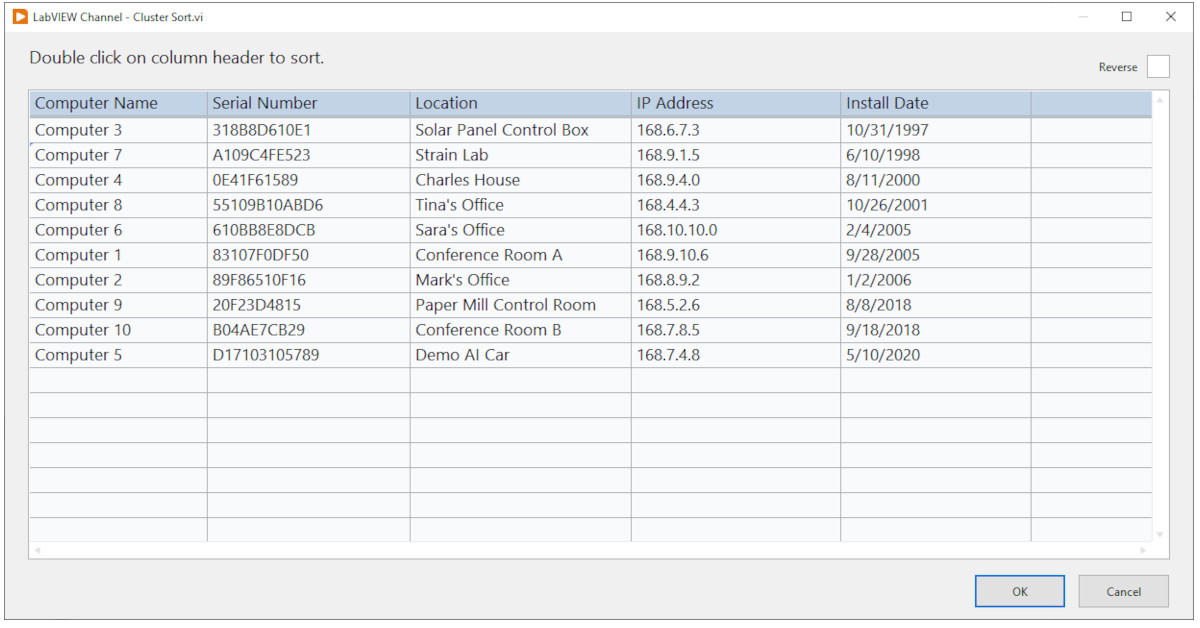
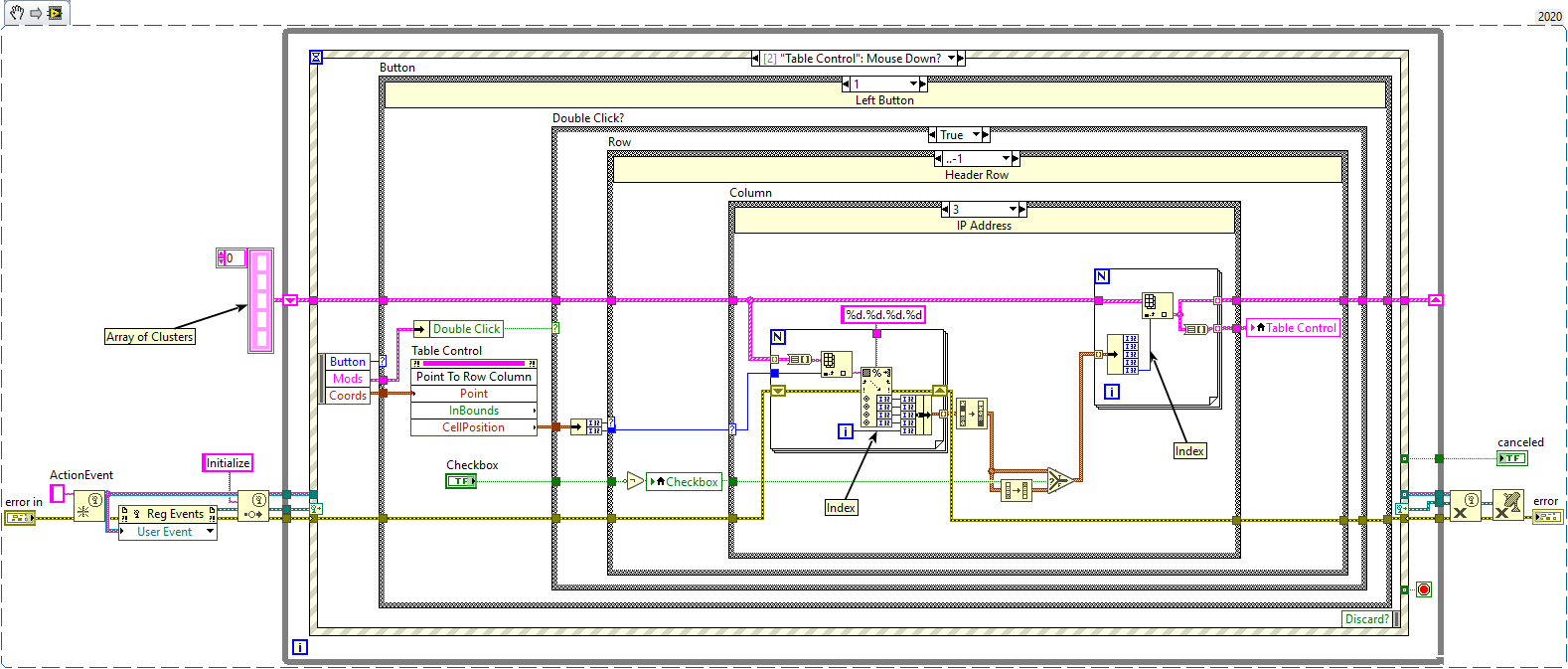
The VI shown in Figures 1 & 2 contains a table that is sorted when you double click on a column header. The VI snippet in Figure 2 contains the VI with subvis removed.
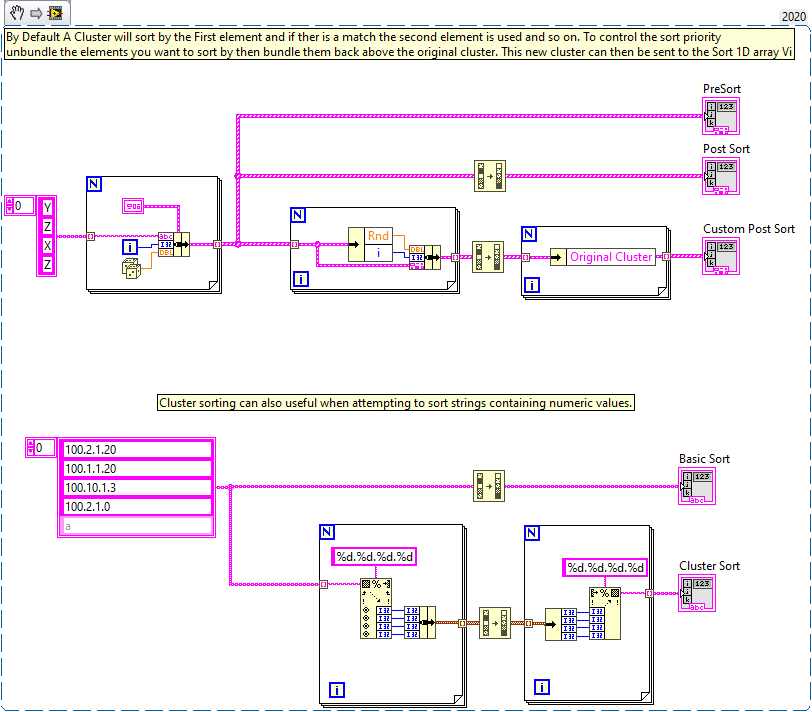
The VI snippet in Figure 3 contains some example array cluster sorting examples. By Default A cluster is sorted by the first element and if there is a match the second element is used and so on. To control the sort priority, unbundle the elements you want to sort by then bundle them back above the original cluster. This new cluster can then be sent to the Sort 1D array VI.
For more information about interacting with large data sets in LabVIEW, or our LabVIEW programming services contact Chase Petzinger @ (844) 837-8797 x704.
Need a custom LabVIEW interface for your data? Talk to the engineers who build them.
Related solutions
iTestSystem Software
Custom LabVIEW interfaces, acquisition, and automated-analytics built around your data. Explore →
DAQ Systems
The data acquisition hardware behind the channels your LabVIEW interfaces sort, plot, and search. Explore →
Engineering Consulting
Custom software and instrumentation engineering for hard-to-solve test and measurement problems. Explore →
Recent insights
-
 Aerospace Engineering, Aerospace Testing, Blue Origin, Engineering, ESCAPADE Mission, Launch Vehicle Engineering, New Glenn, Rocket Reliability, Strain Measurement, structural health monitoring, Structural Testing
How Pre-Launch Structural Testing Ensures Mission Success
When Blue Origin’s New Glenn rocket successfully launched NASA’s ESCAPADE mission to Mars, it marked a historic step forward for commercial launch technology — and a testament to the unseen engineering that happens long before a vehicle ever reaches…
-
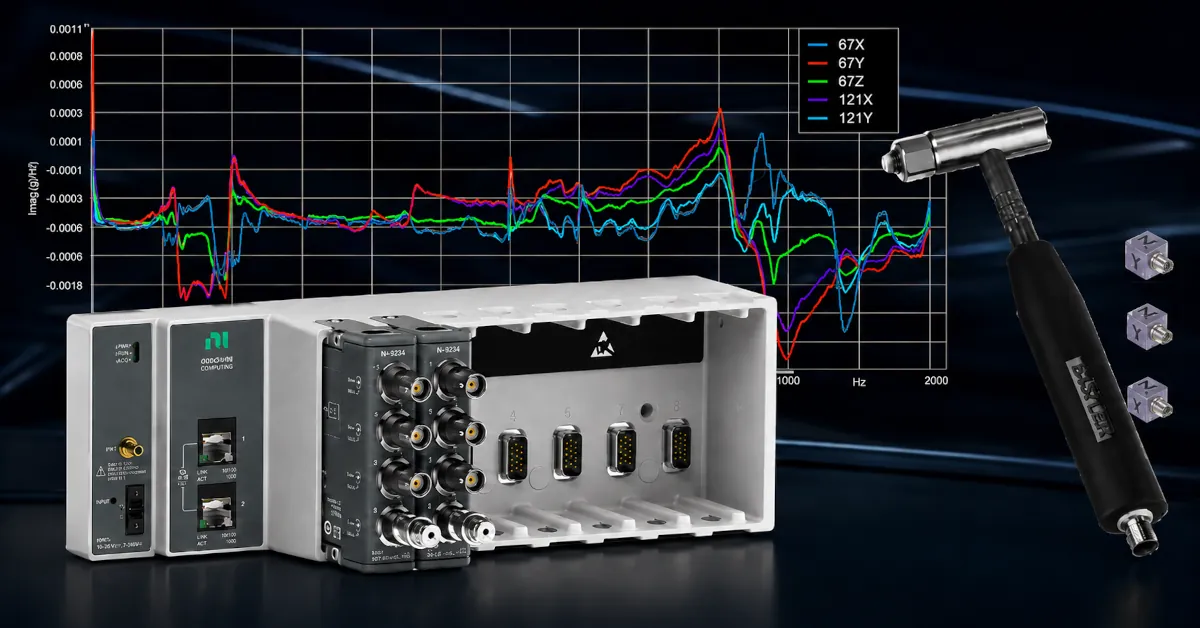 6D Testing & Analysis, Accelerometers, data acquisition systems, design validation, Engineering, engineering measurement, experimental modal analysis, impact hammer testing, mechanical engineering, modal testing, structural dynamics, Structural Testing, vibration testing
Free Engineering Guide: How to Perform Experimental Modal Analysis for Better Structural Insight
Understanding how structures vibrate—and why—is essential across nearly every engineering discipline. Whether you’re working on rotating machinery, industrial equipment, robotics, medical devices, heavy vehicles, consumer products, or building-scale…
-
 AWS IoT Analytics, cDAQ-9189, Channel Synchronization, CompactDAQ, Condition-Based Maintenance, Edge-to-Cloud High-Channel Datalogging, Engineering, Instrumentation, iTestSystem, iTestSystem Automated Analytics, iTestSystem Notification Service, NI-9236, NI-9469, Strain, Stress, structural health monitoring
High Channel Count Synchronous Datalogging
When a manufacturer needed to validate the structural performance of a 38-ton on-highway vehicle, ITM deployed a 200+ channel synchronous datalogging system capable of capturing accelerometer, strain, GPS, and speed data at nearly 2 kS/s per channel…